Showing posts with label Snapshots. Show all posts

Thursday, December 14, 2006

"Mr. Egg... Please Show Me Your ID!"

It is not one day in Hong Kong without getting a warning on TV about poisonous food. Sometimes it is fish, sometimes vegetable or some other fake products, and they all come from China. As a result a brand new market opportunity has been created for "certified good" food. China even created the "Edible Farm Product" label that they grant to brands with strict quality control of their production.

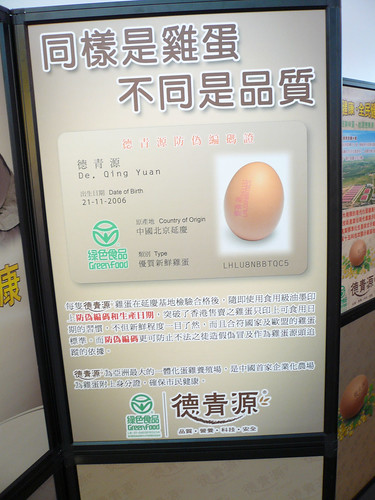
While I was at the Hong Kong Brands and Products Expo, I chatted for a while with Mr. Tony Sin the project director of De Qing Yuan (Website only in Chinese) a Beijing company that is entering the Hong Kong market. Armed with the Chinese Green Food label and a strict process control, they aim at introducing their product - eggs - in Hong Kong by positioning them as the safe option to other brands. Their pricing would be in between normal eggs and "organic" eggs.

Another difference with these eggs will be that the date of production instead of some expiry date will be stamped on the egg itself. Those expiry dates really mean nothing to me as they are so remote in the future (at least in Hong Kong supermarkets), but having the production date on the egg could be scary depending on the speed at which the supermarket can empty its shelves. Although I got used to seeing these expiry date, I don't know what would be my reaction to seeing eggs with a production date long in the past...

In short, there is huge market opportunity here, but isn't it a bit scary that maybe not long from now, while shopping, we will have to choose from the following two sections:

1. Reasonable price, BUT EAT AT YOUR OWN RISK
2. MORE EXPENSIVE, but safe to eat

Tuesday, December 12, 2006

41st Hong Kong Brands and Products Expo

The expo is definitely not what I expected. With a name like that I expected some kind of display of Hong Kong best brands that would promote themselves. Nope Nope... The expo is actually a gigantic market where you can buy whatever you want from brands that are or not from Hong Kong. Food is the main item, but products span from beauty stuff and Chinese medicine to clothing and furniture (photo album on Flickr).

The expo is still interesting to understand what makes Hong Kong consumers buy...

Rule #1: Product demonstration always attract crowds
Rule #2: Display discounts all over your booth
Rule #3: Get a loudspeaker louder than your neighbor's

Or...


Get ready for a looonnnnggggg day

Wednesday, November 15, 2006

When Will They Get It?

Around 2 months ago, my Internet connection stopped working. It took me plenty of courage to get myself to go through the PCCW hotline and solve my problem (I usually prefer going to a store rather than trying Call Centers). As I was on the phone, the support person told me my Now Broadband TV subscription was almost over and that he could propose me some good deals to renew it. He said he would call back two days later.

Time passed...

... and passed...

And two days ago I decided, seeing one of these PCCW Now booths in the street to go and check for myself. I discovered that my contract was already over and that they just had continued to charge the service as usual. Well, I consider myself lucky that they did not start charging more without telling me, so that's fine.

Then the guy started to enumerate the different options I had to renew. Of course all of them were forcing me sign a new contract for 12 to 18 months, even though I have been a customer for more than 18 months. After some negotiation, he told me that there was a way for me to get a nice subscription and 3 months for free. He just had to treat me as a new customer, come to pick up my current set-top box and replace it by a brand new one.

Reluctant to sign for a long contract, I asked him what would happen if I was switching subscription through the DIY (do-it-yourself) TV system they have. He told me: "Well, you would pay full price and get no discount."

To summarize, if as a customer I change my subscription I use the way that costs the least to the company, then I will pay the most (that's DIY). And if I ask the support person to stop my current contract and come to my place to exchange the hardware, then I will pay the least for the service. How could a company do something more mind-bending than that?

Well... This kind of things happen of course everyday, but I just had to write about it!

Saturday, November 11, 2006

The Solution to Branding


Last week-end, as my dad was visiting, I went to Shenzhen to show him the difference between Hong Kong life and China life. Sure enough, you cannot summarize China by looking at Shenzhen, but you see a big difference with Hong Kong right when you cross the border. Colors are paler. It is dusty everywhere because of the continuous construction going on. People look tired. You can tell you are not in Hong Kong anymore. You can tell you are in a country that is developing and in a city that is still struggling to find its identity.

On one of our errands, we saw a celebration in the street. A Hong Kong jewelry brand was celebrating a very important event. That brand had joined the exclusive circle of "CHINA FAMOUS BRANDS" as the certificate that they were showing off explained (see picture on the right).

That got me thinking... How can a certificate, be it from the most important government body, give you the status of a famous brand. Aren't the people supposed to decide which company is famous and which one is not?

Now, I am reading "1 Billion Customers" by James Mc Gregor right now (a book that I recommend to anybody with interest in doing business in China). In the book he explains how the Chinese government when there is a lot of money at stake will find ways to benefit more from it.

To me that example could be one of these. Branding, advertising and marketing in general are great sources of revenue. So, what if the government could issue a document that decided whether you were famous or not, whether your brand was a valuable asset or not, wouldn't that be a great power in the hands of the government?

Friday, November 10, 2006

Targeting the niche

Going mainstream gets harder and harder by the day. Significant behavioral differences and increasing expectations among customers makes it near impossible to develop a message that will reach every consumer. As a result targeting niche segment can become a more and more valuable option. That is one option that the Telecom provider Smartone is following in Hong Kong by targeting explicitly the Filipino community.

Smartone brand is usually red and white, but this store closed to a Filipino hotspot in Hong Kong Causeway Bay has been totally rebranded to fit the community taste and even displays Bahasa language instead of English or Chinese. Shops assistants are of course Filipinos as well. With a huge Filipino community, dedicated Filipino shops are not uncommon in Hong Kong, but it is very uncommon for a "big" company to recognize the fact and spend the effort to research the needs of that community. With no other company following the example as thoroughly, Smartone surely has a huge lead in a community of several hundred thousands.

Wednesday, November 01, 2006

Oh! That's Great!... oh... no, finally no...


That ad is displayed inside the MTR (Metro) in Hong Kong. It is an ad for the fast train that links the airport and a new exhibition hall. It says in big that you can enjoy a same day return trip to the AsiaWorld Exposition Hall for only HK$42, instead of a usual HK$100 if I am not mistaking. That sounds like great! Then you look at the right of the ad with all these street signs displaying places in Hong Kong Island and a big 42 next to each of them...

... unfortunately, when you look at the bottom of the ad, you can see that if you take a full ride from Hong Kong station (on the main island of Hong Kong like the places displayed on the signs at the top right of the ad) to the exibition hall, that will cost you HK$72. Still a nice discount but not as nice as HK$42.

I will never understand how an advertiser can manage customers' expectations so badly. You have a great discount, but by showing IN BIG a wrong figure you actually make people feel bad about the offer and about the company that is seen as trying to trick people. It would have been so easy to display the right price first or at least to change the copy and say: "Same day return trip ticket to AsiaWorld Expo FROM HK$42 up".

Sunday, October 29, 2006

The haircut vending machine

I hate going to the hairdresser. I go there as rarely as I can. Usually I wait until more than 90% of my friends complain about my hair getting too messy before I actually go and get it cut. At that time, I cut as much as possible to make sure I won’t go back that soon. It is hard to compare a haircut and going to the dentist, but to me it is as hard to convince myself to go to either one… if there is no obvious urgent need or symptoms, I won’t go.

In terms of hairdresser, I am not loyal at all. I never had any outstanding experience that made me want to stick to a specific hairdresser. I want a simple cut, nothing fancy. So a good stylist does not make much of a difference. Most importantly I want to spend as little time as possible in the company of the hairdresser. The main things I look at when choosing a new hairdresser is price and convenience. That could be a short version of my persona, summarizing my behavior in relation to getting my haircut.

When walking in the streets of Hong Kong I ended up finding a hairdresser that directly addressed this type of personas. QB House is a Japanese chain that was created in 1996 and that instead on focusing on style, focuses on efficiency. On the door of the hairdresser, then rules are set:

  1. Get a HK$50 note ready
  2. Buy a ticket (no change given)
  3. Wait for your turn
  4. Explain the hairstylist what style you want
  5. The haircut lasts only 10 minutes

When searching on forums, it clearly appears that this concept does not rally all type of crowds. Many are reluctant to try, and it is true that in Hong Kong you can find countless cheap hairdressers that will induce more confidence by focusing more on style. But I can very well imagine the computer geeks in Akihabara district in Tokyo rush to that kind of quick hair salons, enjoying the very systematic process detailed in advance by the hairdresser. With a salon in Hong Kong just next to two major computer and game centers in Wan Chai, the concept can work very well. No need to please everybody.

Thursday, October 26, 2006

Starbucks in China

The news came in yesterday that Starbucks was buying out its local partner in China, thus taking control of around 60 shops in Beijing and Tianjin. The story can be read on BusinessWeek Online in their article "Starbucks Caffeinates Its China Growth Plan".

Below is a quote from the article that highlights the crucial difference that exists between running Starbucks in Western countries and running it in China:

"It's not just a drink in China. It's a destination. It's a place to be seen and a place to show how modern one is," adds Technomic Asia's Kedl. And with China's economy growing in double digits, there are likely to be lots more young urban and modern Chinese ready to sip java in a sleek new Starbucks.

People in China do not go to Starbucks because they like coffee. They do not go there because it is comfortable. Starbucks, just like trendy bars (but maybe appealing to a different crowd), is a place to be seen. Married women go there with their friends to chat and show off their apparel. Families spend the afternoon there reading newspapers proudly showing they can afford two kids despite the one child policy.

So of course, with wealth increasing that fast in China, more and more people will want to show off their newly acquired fortune. But at the same time the process will help create many more alternatives to sipping a coffee in a Starbucks to show off one's wealth. A main threat for Starbucks could be businesses that are more relevant to the culture of China elites. And then Starbucks had better hope that Chinese do actually like coffee... because its early lead could backfire and push it down the value chain.

Wednesday, October 25, 2006

Lost in Malls

In his book “Call of the Mall”, Paco Underhill talks at length about the way mall floor plans and directories are badly designed and make it hard for shoppers to find their way. In one of my expeditions to Mong Kok (most famous shopping district in Hong Kong) I was looking at the small booklets provided by Langham Place shopping mall to help shoppers find their way. These booklets could prove handy in a shopping mall that offers almost 600,000 sq. ft. of floor space and spans over 13 floors!

With my background and experience in usability, it was an opportunity to identify few flaws in the design of the booklet:

Aesthetics driven
The booklet is very nice to look at (the picture on the left presents a front and back view). Unfortunately as it is sitting on the stand at the entrance of the mall, the color difference between the front and the back and the labels “Shopping Guide” and “Dining Guide” lead shoppers to think that these are two entirely different booklets. Many pick two booklets up and only realize after some time that the two are actually the same.

Information Architecture
Another flaw is in the structure of the booklet. It is accordion or zig-zag folded and the title on each side (front and back) should represent what it contains. While holding the booklet on the “shopping guide” side, shoppers can browse a list of all the shops divided in subcategories, with no map of where they are. However on the other side, “dining guide”, the first two pages are dedicated to listing restaurants, while the rest is a series of floor plans to actually locate the shops. I can very well imagine the designer of this booklet thinking that there are too many shops and restaurants compared to the number of floor plans and deciding to group restaurants and floor plans together under a “Dining Guide” category so that the accordion fold CONCEPT would still work…

Not task-oriented
The last flaw of this booklet is that it was not designed with relevant tasks in mind. Shoppers might have two main tasks when taking the booklet. They may need an overview of all the shops available, or they may have a specific shop in mind and want to locate it. First, with subcategories like “The Spiral”, which is a specific location of the shopping mall, it makes it very hard for new shoppers, who do not know the mall’s jargon to get an overview. Second, shoppers who want to locate a specific shop have to look for the code of the shop first, figure out that floor plans are under dining guide and finally look up the shop on these plans; not the most straight-forward of tasks…

It is interesting to see that for an item like a guide to a shopping mall, design seems to take priority over usability.

Sunday, October 08, 2006

Clear Concept

While walking around Mong Kok, which is one of the main shopping area in Hong Kong, here is a picture of a shop that stood out from the rest thanks to its "multiple concepts approach". For me the name "3-concepts" really worked well. I wanted to know more.


It is actually a simple clothing shop and here is the concept they have (written in smaller fonts below the shop name): "Represents either tri-chromatic or neutral, cohering extravaganza paraphrasis together similarly".

A brand always benefits from a clear concept or mission statement. After reading this the shop had lost me as a potential customer. But of course I do not belong to the target audience of this shop. The target audience, young local Hong Kong girls, would not read the smaller captions and just memorize that there was English there, which in itself is a mark of quality.

Obviously in Hong Kong English is not the first language and it is always interesting to see the role that it plays in building customers' perception. Somehow, whatever is written, there has to be English. English role goes beyond making sure non-Chinese speakers can find their way around town...

Thursday, October 05, 2006

When you are not sure... better be general!

A picture taken in a local ParknShop in Hong Kong. This is the leading supermarket here...

After six years living here, I have learnt that you should never ask what your Chinese dish is made of... but at least when I buy ingredients, I'd like a bit more details...


;o)

21 + 3 = 24, 24 + 3 = ...

I have that picture for a long time on my computer. Finally I can post it!


Let's zoom a little on one specific day schedule (all are the same)


A very nice poster from Hong Kong i-Cable company that was displayed during the Germany 2006 World Cup in selected restaurants. This is a provider of cable TV and Internet in Hong Kong. They are losing market share at light speed to broadband competitor Now (PCCW). Although this poster is a very small detail, it may shed light on a much bigger problem overall...

I wonder if some people waited until 27pm to see the game...

Where is the exit?


Everybody knows how an Ikea store works. You follow the arrows – the only path available. First you will go through different kinds of rooms designed with a mix of Ikea furniture and accessories, feeling tempted by how nice these look put together. Next to these rooms you will browse through the complete line of furniture offered by the store. After some time, the accessories section will start with maybe bathroom, kitchen, lighting, etc. one after the other. The formula is a real success.

But what happens when a customer who does not know the concept enters?

That’s what I observed the other day in one of the Ikea store in Hong Kong (Causeway Bay). After some time browsing through the products I turned as I heard: “How the hell do we get out of that thing!” A mother and her daughter were running around shouting and cursing. Maybe they had gotten inside just to take a quick look and now they were like imprisoned not knowing how to escape. Remember the movie “Cube”? Intrigued, and always on the look-out for consumer stories, I followed them as they were going through their struggle.

They continued running around the shop shouting (and for sure not looking at the products). Finally finding a shop assistant, they asked: “Where is the closest exit please?” Then the shop assistant had the best answer to calm down the ladies: “It is pretty far you know…” and then just let them continue their journey along the dreadful arrows. The two poor customers were fuming and just continued to follow the arrows until they finally reached the exit.

The interesting thing about this is that the shop has actually two floors. The store has a first basement floor with all the furniture and then another floor below with basically all the accessories. At the time the ladies were already looking for the exit, they were on the first floor somewhere in the middle. It would have taken only a short time to escape by turning around and heading to the entrance. But with the layout of the store maybe, and with these arrows everywhere, both the ladies and the shop assistant did not even think about this solution. Somehow they had to move forward.

In a way, it means the store is really well designed, as the clear aim of Ikea is to get customers to go through the whole store every time. Nevertheless in this instance this lead only to more frustration for our two ladies; especially when they reached the escalator to go down to the second floor. At this point there was only a glass to separate them from an escalator going up, the exit and the much looked after day light, and they had no choice but to go further down… quite sadistic in a way, no?

In the end these two may not be returning customers… at least not in for while.