There are more and more interactive floors appearing all over town in Hong Kong. These things even though they do not work perfectly are a great way to entertain people and make them interact with their surroundings. And kids especially love it...
Showing posts with label Customer Experience. Show all posts
Showing posts with label Customer Experience. Show all posts
Friday, December 22, 2006


Tuesday, December 19, 2006
Home Coffee Experience
Starbucks reinvented the coffee shop and is covering the whole world with its successful ventures. Another company is now aggressively targeting other untapped locations were coffee is consumed. This company is Nespresso and already showed impressive growth providing coffee to small and medium size corporations as well as to individuals.
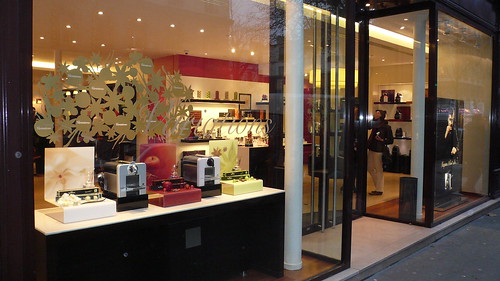
If we move to
Sunday, December 17, 2006
Forcing Change Through Bad Experience
Yesterday night the BBC was announcing the start of a new 8km tram line in
Few Links - 17 Dec. 2006
Below are three links about very different topics...
- From All This ChittahChattah by Steve Portigal is a post called "Signal To Noise". It deals with the appropriateness of online advertising by highlighting a funny example. Highly relevant to any companies investing in online advertising: Don't forget Context!
- From Adverblog is a link to an edugame aimed at making people realize how important it is to save energy in the office. As mentioned in Adverblog, the game is far from perfect, but it still provides some information in an entertaining way. Worth checking...
- From EasthSouthWestNorth is a post about the Hong Kong Ferry Terminal Clock that is to be demolished. It raises the issue of conserving the Hong Kong cultural heritage and how it is best done. I find it very interesting as it deals with the very definition of cultural heritage and how it can be shared in a meaningful way with outside people. I recently brought visitors to the newly built Ngong Ping Village and to see the Symphony of Lights... Both disgraces to Hong Kong culture if you ask me. Especially the Ngong Ping village which is supposed to be dedicated to Buddhism and includes French food, Starbucks and dumb shows that are absolutely not educational.
Thursday, December 14, 2006
"Mr. Egg... Please Show Me Your ID!"
It is not one day in Hong Kong without getting a warning on TV about poisonous food. Sometimes it is fish, sometimes vegetable or some other fake products, and they all come from China. As a result a brand new market opportunity has been created for "certified good" food. China even created the "Edible Farm Product" label that they grant to brands with strict quality control of their production.
 While I was at the Hong Kong Brands and Products Expo, I chatted for a while with Mr. Tony Sin the project director of De Qing Yuan (Website only in Chinese) a Beijing company that is entering the Hong Kong market. Armed with the Chinese Green Food label and a strict process control, they aim at introducing their product - eggs - in Hong Kong by positioning them as the safe option to other brands. Their pricing would be in between normal eggs and "organic" eggs.
Another difference with these eggs will be that the date of production instead of some expiry date will be stamped on the egg itself. Those expiry dates really mean nothing to me as they are so remote in the future (at least in Hong Kong supermarkets), but having the production date on the egg could be scary depending on the speed at which the supermarket can empty its shelves. Although I got used to seeing these expiry date, I don't know what would be my reaction to seeing eggs with a production date long in the past...
In short, there is huge market opportunity here, but isn't it a bit scary that maybe not long from now, while shopping, we will have to choose from the following two sections:
1. Reasonable price, BUT EAT AT YOUR OWN RISK
2. MORE EXPENSIVE, but safe to eat
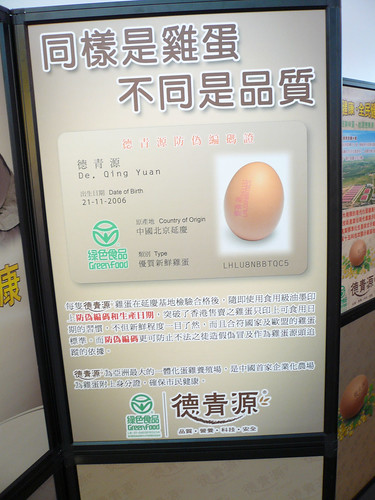 While I was at the Hong Kong Brands and Products Expo, I chatted for a while with Mr. Tony Sin the project director of De Qing Yuan (Website only in Chinese) a Beijing company that is entering the Hong Kong market. Armed with the Chinese Green Food label and a strict process control, they aim at introducing their product - eggs - in Hong Kong by positioning them as the safe option to other brands. Their pricing would be in between normal eggs and "organic" eggs.
Another difference with these eggs will be that the date of production instead of some expiry date will be stamped on the egg itself. Those expiry dates really mean nothing to me as they are so remote in the future (at least in Hong Kong supermarkets), but having the production date on the egg could be scary depending on the speed at which the supermarket can empty its shelves. Although I got used to seeing these expiry date, I don't know what would be my reaction to seeing eggs with a production date long in the past...
In short, there is huge market opportunity here, but isn't it a bit scary that maybe not long from now, while shopping, we will have to choose from the following two sections:
1. Reasonable price, BUT EAT AT YOUR OWN RISK
2. MORE EXPENSIVE, but safe to eat
Saturday, December 09, 2006
TED Talks: Twists of the Mind
I know I wrote that the next few posts would be about cultural differences between France and Hong Kong, but as a good French person I only define rules so that I can have the pleasure to break them… ;o)
 So, here is another TED (Technology, Entertainment, Design) Talk video. This one is by Michael Shermer, founder/publisher of Skeptic Magazine, and author of several books, including Why People Believe Weird Things. It was recorded in February 2006 and last around 18 minutes.
Friday, December 08, 2006
Making the Green Light “Greener”
Back in Hong Kong after two weeks in my home country, France France Hong Kong .
As a first post, I will focus on traffic lights. It is the first time that it struck me, but traffic lights are rather different in some aspects between France and Hong Kong. The main difference I found is that the French green is not as “green” as theHong Kong green… Let me explain...
Hong Kong waiting to cross the road. When the light turns green, you can cross without any worry. No car can come at you as all traffic lights for cars are red. Not so in France
New York Paris Hong Kong finds that despite the crowd the place seems more relaxing than others… maybe European cities could learn from these small things that can make a city nicer to live in.
As a first post, I will focus on traffic lights. It is the first time that it struck me, but traffic lights are rather different in some aspects between France and Hong Kong. The main difference I found is that the French green is not as “green” as the
Thursday, November 16, 2006
Few links - 16 Sept. 2006
- The onliness of Strong Brands is a BusinessWeek article about ZAG, a new book from Marty Neumeier. The book talks about the "onliness" of brands, meaning their uniqueness. It emphasize the need to create unique experiences as opposed to best experiences, arguing that best experiences leads to following common practices and fail to differentiate the brand. The article also emphasizes the need to link brands with long-term trends to create a bridge with customers, as well as be critical towards results from market research that sometimes fail to identify a killer product.
- (Links in French) WAT.TV is an online platform launch by French TF1 (The channel number 1 in France). In LeMonde, leading French newspaper, the article entitled "TF1 fait de la television avec du Web" (TF1 does TV using the Internet) discusses the new strategy employed by the channel to bridge traditional TV programming with the Web. The online platform allows the community to share pictures, videos, text and so on. On a weekly basis, the channel will choose a selection of short videos that they will broadcast late at night on their main channel. The authors of the videos receive Euro 100 for that. I find the approach pretty nice, but I wonder if a significant community can really emerge around a TV channel... it seems too restrictive to me.
- The last link is to the SonyEricsson ad that is showing right now on Hong Kong TV. The ad is very neat and nicely done... but at the end the phone rings and a guy says: "Hello...". Am I the only one who wants to complete the sentence with "Moto"? Every time I see the ad I think about Motorola more than SonyEricsson...
Tuesday, November 14, 2006
Is More Choice A Good Thing?
 Here is another great video taken from TED (Technology Entertainment Design) Talks. This one was made by Barry Schwartz in July 2005 following the release of his book "The Paradox Of Choice" (duration: 20 minutes).
Please go check the Malcolm Gladwell video I posted earlier if you did not watch it.
In this talk, Barry Schwartz builds a very strong argument against providing too much choice to people. He highlights that in regards to choice, although too little is bad, too much can as well have a very negative effect on people on four different aspects:
- Regret and anticipated regret
- Opportunity cost
- Escalation of expectations
- Self-blame
If we look at clothing shops in Hong Kong for example, instead of having a simple Giordano, now you have Giordano, Giordano Ladies, Giordano Junior, Giordano Concepts. With every new type of store created, customers' expectations of how well a specific store can address their needs will increase, thus making it much more difficult to exceed these customers' expectations. Few choices answering specific needs and clear distinctions between each choice, rather than choice overload, is a winning formula.
Tuesday, October 31, 2006
Slides on Mental Models
Below is a pretty nice presentation on mental models from Indi Young, a former AdaptivePath staff member (I found the link to this presentation from Karl Long's ExperienceCurve Blog). Mental models are key to understand the customer experience and identify patterns of behavior. They can be leveraged on to define the features of a product and how they should be organized for example.
Wednesday, October 25, 2006
Customer Experience is about Individuals!
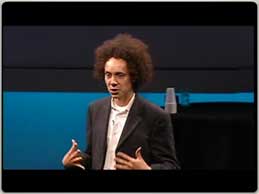 There is a great speech from Malcom Gladwell, the author of bestsellers "Blink" and "The Tipping Point", that I think explains very well the need to consider customers as individuals. It thus complements nicely the concept that customer experience is about individuals as I highlighted in my last post on What is Customer Experience. It also highlights the need to use innovative techniques when researching customers to uncover needs that cannot be identified by direct questioning.
 His talk on “what every business can learn from spaghetti sauce” was made during the TED (Technology, Entertainment and Design) 2004 event in
When watching this, we can wonder how ready the organizations we are working in or we are interacting with are to identify, understand and leverage differences among customers.
Tuesday, October 24, 2006
What is Customer Experience?
Not sexy enough for Asia ?
Customer Experience is a term widely used in theUS Europe . But when I try to explain the concept in Hong Kong where I reside, or in other Asian countries, people go: “Customer what?!”. It appears the concept is very hard to grasp here and very remote from the concepts that govern the market. It is true that in Hong Kong for example, Telecom companies only focus on acquiring new customers without caring at all about their current customers, who receive bad customer service, pay more expensive fees, … and as a result are not “current” for a very long time, as they switch from providers to providers.
The concept of Customer Experience appears also a lot less sexy than Design or Innovation, and as a result receives a lot less attention. The two latter concepts feel quantifiable and concrete. Companies who claim that they can design great products and that they can be innovative now open every day. It would be interesting to count the percentage of companies, which display the word “innovation” or any of its variation on its homepage. Unfortunately for companies inHong Kong , and potentially Asia , who follow the Design and Innovation wave, they do not realize that without understanding customer experience, there is no “innovation” as it is defined today in Western markets or as IDEO is implementing it.
In this post, I will try to add my few cents to define customer experience and highlight the points that are crucial when building an efficient customer experience management structure. Here is how I would define customer experience:
I put this definition is the graph below:

Customer Experience is a term widely used in the
The concept of Customer Experience appears also a lot less sexy than Design or Innovation, and as a result receives a lot less attention. The two latter concepts feel quantifiable and concrete. Companies who claim that they can design great products and that they can be innovative now open every day. It would be interesting to count the percentage of companies, which display the word “innovation” or any of its variation on its homepage. Unfortunately for companies in
In this post, I will try to add my few cents to define customer experience and highlight the points that are crucial when building an efficient customer experience management structure. Here is how I would define customer experience:
“Customer experience is a measure of how well a company performs at any of its touch-points in relation to its customers’ (and prospective customers’) expectations."
I put this definition is the graph below:

It is about emotions!
When considering customer experience, the very first thing to do is to acknowledge that customers are people. A customer cannot be put into a labeled box or market segment and expected to stay there for the rest of his or her relationship with the company. Customers are individuals and we should say customers are changing individuals.
Several factors influence customers. Some uncontrolled factors will affect their perception and expectations of a company. For example outside information like blogs or reports can have positive or negative effects. The customers’ present need is also changing depending on his or her state of mind, the environment, and much more. Apart from uncontrolled elements, the company has a way to regulate expectations using its value proposition communicated through advertising for example. Finally and most importantly, customers’ expectations are regulated by their past experience with a company.
It is about small things!
Focusing on customer experience also necessitates the realization that small things matter. Customer experience will be impacted by things like the tone of voice of a sales person, the weather outside a shop, the blog that a customer read before purchasing a product, the argument that a customer had with his or her daughter the day before, the way the support staff at a competitor’s store handled a problem, etc.
Of course it is impossible to address all these. In the end, the company that succeeds is the one that is able to identify these “small things” and allow enough flexibility in its processes to adapt to them. Some small things may appear insignificant or may even relate to unconscious needs of customers, but they still play a very important part in exceeding customers’ expectations.
It is a virtuous circle!
Experience is not built in one day. Experience is built over time and taking a snapshot at a precise moment may not be enough to understand the whole picture. When looking at customers, companies should look at the interactions they have over time and how these interactions lead to a positive or negative experience. While a negative experience may lead to a customer breaking the relationship all in all with the company, a positive experience does not mean that customers’ expectations will be higher the next time they interact with the company. Yes, they will demand the same level of care, but their expectations will not increase indefinitely.
It actually appears that with time, as discussed in the book “Married to the Brand” written by William J. Mc Ewen (Gallup Press), customers who had a long term relationship with the company are actually less demanding than new customers. This fact even reinforces the need to focus on current customers and exceeding their expectations to keep them longer rather than targeting higher and higher customer acquisition rates.
This post is a first try at communicating about the concept of customer experience and future post will hopefully relate to this definition and highlight examples of how it translates into reality.
Subscribe to:
Posts (Atom)